Thursday, December 30, 2010

Sugar: Can't Think Without It!


SUGAR: CAN’T THINK WITHOUT IT!!

A major secret of superior brain function is to eat in ways that give your brain cells steady access to desirable levels of blood sugar. Neurons cannot convert fat and protein into glucose. The brain consumes 20-30% of the body’s entire energy, and stores so little glucose that it uses it up in ten minutes if not replenished!

Glucose problems (too little OR too much) adversely affect memory, attention span, concentration, excitability, mood, as well as promote dementia and Alzheimer’s disease. Aging brains may need more glucose, as the ability to metabolize it can decline, thus the small storage capacity is decreasing.

Crucial glucose enters the blood mostly from consumption of carbohydrates. The body maintains a certain level of glucose in the blood specifically to serve the brain and central nervous system. Glucose is as much a lifeline as oxygen. It shares the same hazards as both can mutilate and destroy cells. In excess, both can be extremely toxic.

BLOOD SUGAR IS A MEMORY KEY

Creating moderate increases in blood sugar generally improves memory and learning. The harder you use your brain, the more important it is to have adequate blood and brain glucose. When your mind is most active, striving, learning, solving problems, you burn more glucose. Replenish it to continue to function at optimum levels.

BREAKFAST AND BRAINS
Non-breakfast-eaters are shown to be twice as apt to be depressed and four times as apt to have anxiety. Find creative paths to sneak your way into becoming a breakfast eater. Even a small breakfast will make a big difference.

SUGGESTIONS FOR NON-BREAKFAST-EATERS:
Note: I have recently altered this post as I learn more about glucose from Tim Ferriss' book, The 4-Hour Body. You may want to see my blog, This Extra Day, also available on Kindle. On that blog I go into detail about my new food plan and how it is affecting my blood sugar, my brain and my life.

In the 4-Hour Body food plan, breakfast starts with a big hit of protein - within an hour of waking. This is key to flattening out the sugar spikes. So, the adjustment I would make to the following suggestions is to eat two eggs first thing. Ferriss' research shows that people do not eat enough protein in the morning to start the day without going into a cycle of spiking blood sugar.

Other ideas:
Smoked salmon
Black beans and salsa with your eggs

ALL THE DIFFERENCE

The kind of carbohydrates you eat will determine your outcome. This information has changed so radically in recent years you may have to overcome some beliefs in order to assimilate it.

LITTLE-KNOWN FACTS AND ODDITIES:

Interesting findings have emerged regarding combining foods. Vinegar, for example, depresses blood sugar and can save your brain from spikes. Four teaspoons added to an average meal is enough. (Potato salad with vinegar reduces GI 25%). All types of vinegar as well as lemon juice are effective. Acidity is the reason. Lactic acid also helps, which is why yogurt has a low GI even with sugar.

A.G.E.
Sugar-damaged proteins turn yellowish-brown and are called advanced glycosylation end products (A.G.E.). The process is similar the browning a chicken where the skin gets crispy. We are all undergoing this browning process as we age. Research shows the main culprit in AGE is high glucose levels in the blood. Simple sugars appear to be the most damaging. A diet consistently high in simple sugars shortens lifespan and increases all the negative outcomes of brain aging.

White flour raises blood glucose faster than ice cream, and white potatoes raise blood glucose faster than pure sugar! Ouch.

HIGH FRUCTOSE CORN SYRUP is this culture’s most common culprit for the damage from simple sugars. Guess where high fructose corn syrup is most commonly found. You got it. Sodas. Even the “healthy” ones. Check the labels.

HELPFUL SUPPLEMENTS:
Take alpha-lipoic adic (50-100 mlg/day), along with chromium (200 mcg) to help normalize blood sugar.


Sweet blessings to you!
Suzanna Stinnett

Friday, December 10, 2010

Breathing for Brain Restoration


The Breath of Fire increases mental and physical energy – try doing it for two or three minutes.

From a Western perspective, the Breath of Fire – using quick abdominally-focused breaths – is believed to be effective because it stimulates the splanchnic nerves in the abdominal cavity. Stimulation of these nerves causes the release of epinephrine and norepinephrine.

To do this exercise, breathe through your nostrils rapidly – more than one inhalation per second. Do not pause between inhaling and exhaling.

You should inhale by bringing your diaphragm down rather than up. Breathe from your diaphragm, with your chest relaxed. Focus on your navel area.

You might experience a mild feeling of light-headedness. However, this is likely due to increased alertness. Clinical studies have indicated that while the carbon dioxide level in the blood remains normal, the oxygen level actually increases during the Breath of Fire. Other studies indicate that the Breath of Fire produces alpha rhythms in the brain. This is probably why the exercise is able to simultaneously create increased calmness and increased alertness.

This breathing exercise may work by increasing oxygen delivery to the brain, improving neuronal metabolism. The neurons are thereby rejuvenated.

Some people use the Breath of Fire for quick energy in the afternoon—instead of a candy bar or cup of coffee. I’m using it today to relieve my brain fog. It’s the first rainy weekend of the winter, and my body is responding with a serious case of the “sleepies.”

If this breathing exercise does not give me the wakefulness I am looking for, I’ll turn to another tried-and-true brain refresher (and tomorrow’s topic): an afternoon nap.

Best wishes,
Suzanna Stinnett

Friday, January 12, 2007

Converging Information on Brain Function, Aging and Health
One reason we are just beginning to learn effective ways to grow brains throughout life is that information from the scientific community has changed dramatically over the last decade. The news is all exciting, and as we begin to do the things that make a difference, we will have more brain power to digest the developing information.
Jeff Victoroff, M.D., associate professor of clinical neurology at the Keck School and director of neurobehavior at Rancho Los Amigos, suggests, "Genetic evolution may have favored those who, once they hit the old age of 35, retained the capacity to teach and provide emotional support rather than those whose brains' limited resources were devoted to new learning." In evolution 100,000 years ago, he says, "It was probably rare for people to live past age 40 or 50, which means there was very little evolutionary selective pressure to make the brain work when we're 60 or 70 or 80. That's probably why all brains decline with aging."
What is most intriguing about the new findings in brain aging is that they indicate that the rate of change may be hastened or slowed by lifestyle factors. For instance, maintaining a lower weight might affect brain aging.
Steps like strict control of blood pressure, blood sugar and cholesterol, diet, the use of certain vitamins, physical exercise and mental exercise to help keep the brain functioning at its peak. "These are probably things 15 year olds should be doing, because the effect on the brain is cumulative," he says. "It certainly helps if someone in their 40s, 50s or even 70s starts to take the right steps, but the younger you are, the larger an impact it will have on delaying brain aging."
Victoroff and others are optimistic that the future will bring better understanding-and treatment-of brain aging and its associated symptoms. Drugs now in preclinical or Phase I human trials to treat Alzheimer's, says Helena Chui, M.D., co-director of McCarron Clinical Research and Education Center at USC in Downey, California, may decrease the levels of amyloids in the brain. Other experiments now underway suggest that deterioration in critical brain networks may be restored by gene therapy-transplanting brain cells genetically programmed to release a protein called nerve growth factor. The research focuses on a particular set of brain cells deep in the brain known as cholinergic neurons, which are shown to deteriorate rapidly in those with Alzheimer's disease.
"Studies show that the human brain is built to go for an amazing length of time," says Caleb Finch, Professor of gerontology and biological sciences. Ten years from now, "we'll have a greater understanding of the long-term risk factors that have adverse effects on the brain. We'll know which people are more at risk earlier in their lives because of their genes. Knowing more about genes and the environment is not likely to yield a magic bullet, but each decade will nibble away at the adverse aspects of brain aging."
Adds Victoroff, "Although we need to know a great deal more, we are long overdue in recognizing a simple fact: Cognitive loss is largely preventable. This is a watershed point in our understanding of dementia. Once the news gets out, it will percolate into the public's consciousness and begin to influence behavior."
Influencing public behavior is where Brain Whisperers come in. Those of us working to bring this information to an ever-broader audience are excited about increasing the potential and possibilities available to the millions of aging Baby Boomers, their elderly parents and their bright kids and grandkids.
To your health,
Suzanna

Tuesday, January 09, 2007


Friendship

Article by Gale Berkowitz, 2002
A landmark UCLA study suggests friendships between women are special. They shape who we are and who we are yet to be. They soothe our tumultuous inner world, fill the emotional gaps in our marriage, and help us remember who we really are. By the way, they may do even more.
Scientists now suspect that hanging out with our friends can actually counteract the kind of stomach-quivering stress most of us experience on a daily basis. A landmark UCLA study suggests that women respond to stress with a cascade of brain chemicals that cause us to make and maintain friendships with other women. It's a stunning find that has turned five decades of stress research---most of it on men---upside down. Until this study was published, scientists generally believed that when people experience stress, they trigger a hormonal cascade that revs the body to either stand and fight or flee as fast as possible, explains Laura Cousin Klein, Ph.D., now an Assistant Professor of Biobehavioral Health at Penn State University and one of the study's authors. It's an ancient survival mechanism left over from the time we were chased across the planet by saber-toothed tigers.
Now the researchers suspect that women have a larger behavioral repertoire than just fight or flight; In fact, says Dr. Klein, it seems that when the hormone oxytocin is release as part of the stress responses in a woman, it buffers the fight or flight response and encourages her to tend children and gather with other women instead. When she actually engages in this tending or befriending, studies suggest that more oxytocin is released, which further counters stress and produces a calming effect. This calming response does not occur in men, says Dr. Klein, because testosterone---which men produce in high levels when they're under stress---seems to reduce the effects of oxytocin. Estrogen, she adds, seems to enhance it.
The discovery that women respond to stress differently than men was made in a classic "aha" moment shared by two women scientists who were talking one day in a lab at UCLA. There was this joke that when the women who worked in the lab were stressed, they came in, cleaned the lab, had coffee, and bonded, says Dr. Klein. When the men were stressed, they holed up somewhere on their own. I commented one day to fellow researcher Shelley Taylor that nearly 90% of the stress research is on males. I showed her the data from my lab, and the two of us knew instantly that we were onto something.
The women cleared their schedules and started meeting with one scientist after another from various research specialties. Very quickly, Drs. Klein and Taylor discovered that by not including women in stress research, scientists had made a huge mistake: The fact that women respond to stress differently than men has significant implications for our health.
It may take some time for new studies to reveal all the ways that oxytocin encourages us to care for children and hang out with other women, but the "tend and befriend" notion developed by Drs. Klein and Taylor may explain why women consistently outlive men. Study after study has found that social ties reduce our risk of disease by lowering blood pressure, heart rate, and cholesterol. There's no doubt, says Dr. Klein, that friends are helping us live longer.
In one study, for example, researchers found that people who had no friends increased their risk of death over a 6-month period. In another study, those who had the most friends over a 9-year period cut their risk of death by more than 60%.
Friends are also helping us live better. The famed Nurses' Health Study from Harvard Medical School found that the more friends women had, the less likely they were to develop physical impairments as they aged, and the more likely they were to be leading a joyful life. In fact, the results were so significant, the researchers concluded, that not having close friends or confidants was as detrimental to your health as smoking or carrying extra weight.
And that's not all. When the researchers looked at how well the women functioned after the death of their spouse, they found that even in the face of this biggest stressor of all, those women who had a close friend and confidante were more likely to survive the experience without any new physical impairments or permanent loss of vitality. Those without friends were not always so fortunate. Yet if friends counter the stress that seems to swallow up so much of our life these days, if they keep us healthy and even add years to our life, why is it so hard to find time to be with them? That's a question that also troubles researcher Ruthellen Josselson, Ph.D., co-author of Best Friends: The Pleasures and Perils of Girls' and Women's Friendships (Three Rivers Press, 1998). The following paragraph is, in my opinion, very, very true and something all women should be aware of and NOT put our female friends on the back burners.
Every time we get overly busy with work and family, the first thing we do is let go of friendships with other women, explains Dr. Josselson. We push them right to the back burner. That's really a mistake because women are such a source of strength to each other. We nurture one another. And we need to have unpressured space in which we can do the special kind of talk that women do when they're with other women. It's a very healing experience.
Taylor, S. E., Klein, L.C., Lewis, B. P., Gruenewald, T. L., Gurung, R. A. R., & Updegraff, J. A. Female Responses to Stress: Tend and Befriend, Not Fight or Flight" Psychol Rev, 107(3):41-429.

Monday, January 08, 2007

Tender Care

A membrane envelopes the entire brain like a soft sack. This thin, essential covering is called the "pia mater." One medical dictionary I used years ago showed a translation of pia mater as "tender, affectionate mother."

The delicate membrane protects the brain without creating any pressure or restriction.

If we contemplate our brains with this kind of loving care, we may easily remember to do the things we know will help preserve cognition and grow an ever greater capacity for vibrant living.

With love,
Suzanna

Sunday, January 07, 2007

The Brain Reorganizes

Fascinating work from Columbia University in New York has found that people who've been born with abnormal collections of blood vessels in their brains have managed to reorganize their brain function — sometimes right to the opposite side to where it normally is.

These lumps of arteries and veins are called arteriovenous malformations, and they grow steadily, only to show themselves when someone's in their thirties or so with a bleed or signs of pressure.

So there's been years to allow the brain to cope.

What about strokes, though, which are usually sudden events? Is the brain plastic enough to re-distribute function when the timeline is hours and days?

Well the answer seems to be yes. In fact, what sometimes occurs is that the brain can take a function like speech and move it somewhere else for a while till the original area heals, then move it back. They know this from scans, and occasionally from the tragic circumstance when the new area suffers a stroke and the function is lost a second time.

The researchers have also found that Valium-like drugs — the benzodiazepines — can temporarily bring back the disability of a stroke after the person has recovered.

This sounds like bad news, but it's actually given the researchers a clue to what might be happening in the brain — and the possibility that there might be a chemical messenger which speeds the re-distribution rather than hampers it.

The substance which has shown the provide the most protective action against stroke is Vitamin E, followed closely by CoQ10. Vitamin E is so well documented as protection from stroke and heart disease, it's worth taking daily as a preventive.

Vitamin E is also one of the major antioxidants. There are a few antioxidants which have the ability to "pitch hit" for each other. This means that when your system is low on one antioxidant, others can loan molecules to re-establish healthy levels of each antioxidant or neurotransmitter.

To your health,
Suzanna

Saturday, January 06, 2007


Possibilities for the Long-Lived Brain

As I explore the diverse avenues which are brain-related topics, searching for everything of interest to my readers, I am bolstered by other writers who, like me, recognize the vast treasure of the mature brain. This is the main reason I do this work. I see the aging population as one of our primary social and cultural resources. I want to preserve that brain power. I want to increase that brain power. I want to connect that brain power.

As Bill Novelli points out in the December 2006 issue of AARP, "We are at a unique moment in history when the need for change, the demand for change, and our ability to create change are coming together." His book, "50+: Igniting a Revolution to Reinvent America," focuses on this tremendous capacity this population holds.

There is a great synergy between a 50+ individual finding activities that boost brain power and the needs of our culture and our world for solutions. Participation may be the best prescription for both. In the world of neurogenesis (new neural growth), reaching out from your heart and connecting in meaningful ways with your world are the pillars of a long and vibrant life.

Yours,
Suzanna

Friday, January 05, 2007


Habit? Rut? Ravine?

While we're learning how to give our brains what it wants for robust neural activity, another little life challenge is worth mentioning.

Mental habits are the background of behavior. These electrical impulses are so imbedded, they go unseen for the most part. However, they are not unchangeable. You can begin to unveil that background by trying small new actions. For example, stop yourself when you are doing something absolutely routine -- like getting milk (rice, almond, soy or cow) out of the refrigerator in the morning. Any tiny change will begin to redirect brain signals and can start showing you just how deep that brain rut has gone. Standing at the refrigerator, just step back and close the door again. The wiring that automatically swings an arm in, grabs the milk carton and then moves to clear the door has been interrupted. The neurons are searching for direction. If you are interrupting a very entrenched signal, you may feel off balance, annoyed, or confused.

Good!

You're getting information about your brain's wiring.

Emotional ruts can be the real ravines. The other day I noticed I was having hurt feelings left and right. When I wasn't engaged in conversation with someone who was "hurting my feelings," I was imagining a hurtful exchange. Hello? This is a rut, or, as the day went on, I began calling it a ravine. I decided to explore the territory a bit, looking at the old triggers for such a habit. Childhood, no doubt. I made an executive decision about the importance of knowing the details, and rather than try to recreate the original hurt, I embraced the part of me that still goes there. Just allowing this process grows neurons and starts to dismantle mental habits.

I asked myself what other options I had, right now, for feeling my life. Turning to gratitude, the great cleanser, I realized I was overwhelmed by gratefulness. This was a profound shift. Now I was in a completely different area of my brain, and I could feel it.

Mental habits can and usually do induce a chemical cascade in the body. These are the familiar feelings we wake to over and over, wondering why we are torturing ourselves. Remember, they're habits. Neural pathways the brain takes because the triggers are there. We have enormous power over this, if we choose to use it. Turning from hurt to gratitude is one example of the power of stopping, listening, and embracing one's inner landscape.

Brainglorious!

Suzanna

Thursday, January 04, 2007


Here's an excerpt from Dr. John Eaton, who believes that the body has important messages to share with us. I think he articulates his view in a very interesting way. Viewing the body as another form of brain is not new. As scientists continue to explore this realm, we may see much more work like Dr. Eaton's, helping us to apply this perspective in our daily lives.

How Bodymind works

Bodymind is the intelligence of the body, working through the Brain, the Nervous System, the Glands, the cells and the Immune system. Its primary function is to ensure the safety of the individual and to maximize health and happiness. There are a variety of ways in which Bodymind works towards this and here are just a few:
• Renewing cells and tissues
• Converting food into energy
• Refreshing the system with oxygen
• Repairing damage to bones, skin and the organs
• Harmonizing the different body functions
• Guarding against infection
• Using emotions to guide the person towards action
• Can use symptoms of certain kinds to let the person know she is in
danger when emotions are not being resolved.

In each case we can see Bodymind working towards our survival. In the case of the last two functions, Bodymind is protecting us in a different way. It is using emotions and then (as a last resort) certain kinds of symptom to communicate to us that we are at risk of harm from the environment. The wisdom of Bodymind consists in picking up information about situations going on out there and then sending emotional signals through to us to tell us what to do about them.

One important function carried out by the emotional brain is to provide a kind of `emotional radar' in which information about the environment is matched to a cellular memory, triggering an emotional opinion about what is happening, which then leads to production of an emotion in order to encourage, warn, guide and protect the
individual.

For example, someone shouts at you. Before you are conscious of the fact the Thalamus has already registered that there is a red face moving towards you, the voice is loud, and your personal space is being invaded. Immediately the Amygdala presses the alarm button on the nervous system and you are instantly aroused for action. Meanwhile, the Hippocampus matches information from the Thalamus against past experiences of teachers/parents shouting at you and sends a signal to the Hypothalamus to co-ordinate a fear response (or an anger response, or both). Bodymind then waits for you to take protective action and prepare for self-assertion. Through the Limbic system and the Hypothalamus, Bodymind can influence the glands, the immune system, the autonomic nervous system, the skin, muscles, gut, heart, circulation and breathing. In this way we can notice the intimate connection between emotions and physical state. And, by inference, between emotional health and physical health.

Bodymind and the emotions

Here are two closely linked emotions which have to do with long-term survival:

Excitement. Bodymind is confirming to us that the activity we are moving towards is of great value to us and wants to encourage us to do so with urgency.

Joy. Bodymind is confirming that we are doing things (or engaging in relationships) that are absolutely right for us. Bodymind is also urging us to share our pleasure and satisfaction with other people, so as to deepen our relationship with them. Sharing reinforces the emotion of joy.

The regular production of excitement and joy are vital to health because they confirm that we are pursuing the kind of life that is best suited to us and in which there is at least one relationship based on love, worthwhile work and opportunities for us to selfactualize, meaning that we are making the optimum use of the skills, talents and wisdom we were endowed with at birth. These emotions are also linked to the release of endorphins.
You can read more of Dr. Eaton's work at www.reverse-therapy.com.

And remember, the action of smiling sends a signal to the brain that it is time to feel happiness. Just one little shift in reverse.
Warmly,
Suzanna

Wednesday, January 03, 2007

Mood Stabilization and Improvement

As I continue to experiment with supplementation of available neurotransmitters, one that I find makes a consistent difference is alpha-lipoic acid.

ALA is also known as thioctic acid, and it is a powerful antioxidant as well as a cofactor in the body’s production of energy. It augments the actions of the hormone insulin, helping to keep the brain steadily supplied with glucose. In scientific studies, ALA has been shown to produce improvements in energy metabolism in the brain.

Alpha-lipoic acid is readily available at your health food store, and it is quite inexpensive. I take two 50 mg tablets every morning. Along with my women’s formula B-vitamin complex, fish oil, and CoQ10, ALA is one of my staples.

ALA shows no adverse side effects, and may make a noticeable difference in stabilizing and improving mood. The brain is an organ whose primary role is special “switching” and “signaling” operations, and requires that the neuronal membranes can properly regular excitability and osmolarity.

In later blogs, I will look into all the neurotransmitters which we are able to supplement.

Be well,
Suzanna

Tuesday, January 02, 2007


Green Tea Magic

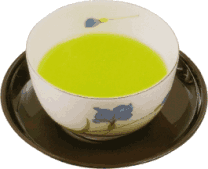
Scientists have only begun to discover the health benefits of green tea. A recent study at the University of Purdue concluded that a compound in green tea inhibits the growth of cancer cells. And the Chinese have used green tea as medicine for over 4,000 years, treating everything from headaches to depression. There is also evidence that drinking green tea reduces total cholesterol and improves the balance of good-bad cholesterol in the bloodstream.

Studies vary in the recommended amounts of green tea, but to receive real benefit for the immune system, protection from cancer, relief of rheumatoid arthritis, and lowering of cholesterol, you would need to drink four to five cups per day.

Brewing green tea is slightly more complicated than black tea, as you should bring water to a boil and then allow it to sit for two or three minutes before pouring the hot water over your green tea. Then allow your tea to steep for about three minutes. One to two teaspoons of the tea leaves should make a very nice cup. Green tea does have caffeine, although in minor amounts. If you drink black tea or coffee, you might replace your afternoon coffee with a big cup of green tea.

With the winter storm brewing outside right now, I think I’ll go put the kettle on!

Blessings,
Suzanna

Monday, January 01, 2007


Body and Brain Engaged in Learning

Here is a description of the thought process from the neuroscience community:

1. A message is transmitted from one neuron to another through an electric-chemical process.

2. The outgoing message travels to the end of the axon (the little runway of the brain cell connecting the two ends), where a synapse is located. The synapse is defined as the end of an axon and the receptor on a dendrite between these 2 structures: the synaptic gap.

3. The electric signal, or outgoing message, releases the chemical message.

4. The message crosses the synaptic gap.

5. The dendrite of the neighboring brain cell receives the message if the information is stimulating enough.

6. The threshold for activation of a particular neuron is determined by a complex interplay of one's genetic code, physical condition (tired, in pain, alert), and environment (noisy, light, cold, stimulating).

7. The chemical message now becomes an electric signal again and travels from the dendrite to the cell body, passes through that cell's axon to another cell's dendrite, and the process continues.

8. Frequent transmissions of information between particular neurons can establish a permanent relationship between them.

Two of these points are very interesting to me today. Number 5 says “if the information is interesting enough.” I look at the motivation it took for me to learn to ski downhill this weekend, and relate to the concept that the information was not only interesting to me, but more so because I earnestly wanted to learn. I watched my fellow students in the beginner classes as they struggled with the same obstacles. Some were there because their spouse or friends insisted they “try it!” None of these students progressed through the first hurdle – coping with the awkward, heavy, and tiring equipment.

The second point of interest is Number 8. As I played along with the instructor’s requests, I listened to the signals traveling back and forth through my neural systems. The first day, many of my thoughts were counterproductive. An ongoing conflict played out: I want to sit down, I can’t stand on the skis, I don’t want to fall. The instructor coaxed us down the hill. I don’t want to go fast, I can’t turn, my skis aren’t responding, I’m hot, I’m cold, I’m thirsty, I’m tired. But the motivation won out. I wanted to be able to make it down the hill so I could ride the lift! Uh-oh. Another conflict: Getting off the lift. A notorious difficulty as the lift chair grazes the snow bump before it makes a u-turn. You have to get off the chair, go straight down a short hill, and try to remain standing. Neurons stack up like impatient skiers waiting for the lift: I can’t stand up! It’s like jumping out of the lift chair! Who would do that?

Me.

Now, if those “permanent” signals will last until next weekend, when I can build some more neural pathways on the little hills.

Peaceful blessings for your new year,
Suzanna

Sunday, December 31, 2006


Brain and Body

I learned something today.

After yesterday's mental and physical work to keep my body in those ski boots and on the snow, attempting to follow instructions, I experienced that accumulation of signals. Brain and body clicked.

Jim, the director of the learning center at Tahoe Donner ski area, took me on the slopes for a couple of runs, and I came out a skier. That second time we went on the lift back to the top of the little hill, I thought, "ho boy, here I go, my legs are wobbly and I don't know how to do this." Jim is an accomplished skier and instructor, and his deftness was all my benefit. Encouraging down and down and down the slope, every turn and stop was information on a massive scale. After we finished, I continued a little way further down the slope on my own, and had the phenomenal rush of "AHA!" as gravity, my skis, and my body merged into the smooth movements of downhill skiing. For at least ten seconds.

Jim explained all the things I didn't know, and did it with metaphors I understood: Driving a car - reach for the steering wheel. Pedaling a bike, push with the right, push with the left.

I was delirious when I realized I had just learned how to ski. I looked across the snow at the spot I wanted to head for, and I went there. Magic.

How many dendrites have I triggered into growth during these two days? It occured to me that I've engaged a number of brain areas, and one that is missing is music. I decided to figure out a little tune for myself for the afternoon's runs.

I'm flat out in awe of the feeling of discovery at this level of engagement. I'm grinning, and eager for more. What can I learn next?

Where's your "aha"?

Wishing you a year of awe,

Happy New Year,
Suzanna

Saturday, December 30, 2006

Brain Activation: First Skiing Lessons

Just to stand on the hillside in ski boots, on the skis, shifting weight from foot to foot is so strange and new, I do not have the kinesthetic signals to do it. I use my imagination, listen to the instructor, and say under my breath, "grow, dendrites, grow."

All the visuals are new, too. A huge white bowl, the lifts carrying skiiers and skis and poles and snowboards up to the top, trees along the ridge and the sky criss-crossed in contrails. I shift left, right, and my eyes take it in.

The little class of beginners is going down the hill now. "Single file," the instructor says, "follow me, do what I do!" I'm able now to travel along the angle of the slope, control my speed, snowplow. I'm learning a new language along with all the kinesthetic information.

Ski patrol zooms down to help a troubled skiier sprawled in the snow. I see the red jacket, as he finishes up and takes off again, the first-aid cross on the back. I sense I am cataloguing the elements of my environment.

Tomorrow, evidence of brain growth is expected. I'll be able to turn, and can spend some time doing something easier than getting up out of the snow, my legs pinned in a pretzel of skiis. I'm banking on that dendrite growth, and I'll take a little extra CoQ10 and Vitamin C to help it along.

Tonight, rub sore muscles, drink water, eat good food, laugh with my new friends, watch the fire. Regeneration.

Taking on new, challenging, and complex activities after 50 is pure Activation.

2007 is upon us. Have you considered what joyful Activation you might engage in the coming year?

Blessings to you,
Suzanna

Friday, December 29, 2006

My Newness

I have this Activation under way. I'm going downhill skiing for the first time in my life. That sounds like enough, I'd recommend it for an Activation activity for sure. What I'm looking at today, though, is the range of new neural pathways I'm experiencing in the process of getting to the mountain.

First there was the foreign foot experience. Buying ski boots was an utterly foreign foot expereience. Zhort, the extravagantly handsome Hungarian athlete who fits ski boots at the Sports Basement in the Presidio, instructed me. I stood in the rigid structure that is known as a modern ski boot. "Lean forward in the boot," Zhort said in his crisp accent, "push with your shin. Now your toe should come back in the boot."

I sat with the boots clamped onto my feet, settling in, watching for spots that hurt.

Sensory input traveled along to my brain. They're tight. They're rigid. My brain is listening.

Now we are traveling along I-80 in heavy traffic headed for the mountain. This is something else I have rarely done. Highways in heavy traffic is not a brain activator for anyone who commutes regularly -- seriously not recommended. But for me, today, I am taking in visuals and sounds and cultural stories left and right.

Night settles in and a half moon lights the slopes. I get my first look at snow.

We meet new friends at a mexican restaurant in Truckee, and make merry with Charley's son and his crew who have just finished dinner. New sights. New people. New stories. Dendrites galore!

A wonderland of experiences await. I'm contemplating the description of going in a long, slow "S" down the hill, letting the skis take me. Tomorrow, the slopes, and who knows what else!

to be continued...

Suzanna

Wednesday, December 27, 2006


Thinking With Heart

Today I offer a window into one of our new sciences. The following excerpt is from an article found on the Heartmath site. You can read much more about the new discipline called "neurocardiology" by searching for "heartmath" on Google or another search engine.

THE RESONANT HEART
Rollin McCraty, Raymond Trevor Bradley, Dana Tomasino

The Body's Heart Field
Heart Field: An electromagnetic field produced through the heart that can be detected several feet from the individual.

Many believe that conscious awareness originates in the brain alone. Recent scientific research suggests that consciousness actually emerges from the brain and body acting together. A growing body of evidence suggests that the heart plays a particularly significant role in this process.

Far more than a simple pump, as was once believed, the heart is now recognized by scientists as a highly complex system with its own functional “brain.” Research in the new discipline of neurocardiology shows that the heart is a sensory organ and a sophisticated center for receiving and processing information. The nervous system within the heart (or “heart brain”) enables it to learn, remember, and make functional decisions independent of the brain’s cerebral cortex. Moreover, numerous experiments have demonstrated that the signals the heart continuously sends to the brain influence the function of higher brain centers involved in perception, cognition, and emotional processing.

In addition to the extensive neural communication network linking the heart with the brain and body, the heart also communicates information to the brain and throughout the body via electromagnetic field interactions. The heart generates the body’s most powerful and most extensive rhythmic electromagnetic field. Compared to the electromagnetic field produced by the brain, the electrical component of the heart’s field is about 60 times greater in amplitude, and permeates every cell in the body. The magnetic component is approximately 5000 times stronger than the brain’s magnetic field and can be detected several feet away from the body with sensitive magnetometers.

The heart generates a continuous series of electromagnetic pulses in which the time interval between each beat varies in a dynamic and complex manner. The heart’s ever-present rhythmic field has a powerful influence on processes throughout the body. We have demonstrated, for example, that brain rhythms naturally synchronize to the heart’s rhythmic activity, and also that during sustained feelings of love or appreciation, the blood pressure and respiratory rhythms, among other oscillatory systems, entrain to the heart’s rhythm.

(End)

I am currently looking over other studies on electromagnetic pulses and the various ways the brain and body communicate. This does put a different slant on listening to your heart!

Be well,
Suzanna

Tuesday, December 26, 2006


Development Varies In Different Areas of the Brain

At the Keck School of Medicine at USC, Ione Fine, Ph.D., was the principal investigator of a study on brain regions which respond selectively to cues of gender, ethnicity and identity cues in the faces of others.

The study showed that some people have an inability to make distinctions such as these, even failing to recognize obvious gender cues. Most of the population is likely to fall in the midrange of this ability, with some able to detect a slew of identity features at a glance.

The next time you realize that your companion didn't notice the waitress was speaking with an Italian accent, consider the possiblity that he or she may not have this particular brain development at the same level as you. The idea that we have such a range of individual brain development can help us to accept all kinds of differences in others. Our experiences of the world are truly as unique as our fingerprints.

What details of your environment do you tend to notice most?

Lightly,
Suzanna

Sunday, December 24, 2006


Relax, Relax, Relax

Letting it all go is a prescription for brain regeneration and neural integration. As we enjoy these deep winter nights, remember to drink an extra glass of water here and there, have some good laughs with loved ones, and allow that delicious sleepiness so natural to our wintering bodies.

The pace awaits, no doubt.

For now, let go, and dream.

Yours in light,
Suzanna

Saturday, December 23, 2006


DEACTIVATION TECHNIQUES?

The process I call "Activation" is based on aspects of brain chemistry which are most likely to produce dendrite growth. There are also things you can do which DE-activate brain growth, actually lowering brain activity and in effect putting your healthy, ready-to-fire neurons to sleep.

An obvious deactivation device showed up in today's paper as an advertising insert. Guess what it is. Right! Hey, you are really on today! That GPS device that is being sold actually replaces a powerful brain builder called NAVIGATING. When we use our brains to find an address, we employ many different areas of the brain. We call on areas related to memory, innovation, spatial skill, and creativity, to name a few.

Technology has given us so many powerful and positive things. Like being able to reach all of you with this blog, for example. However, let's pay attention to the healthy and life-enriching activities that may be replaced -- and soon lost -- by relying totally on devices such as the GPS.

Anyone seen my abacus?

Cheerily yours,
Suzanna

Friday, December 22, 2006


A Little Holiday Encouragement

Scientists are still working hard to understand the most productive actions we can take to stave off Alzheimer's Disease. We don't have enough to go on, and some 4.5 million Alzheimer's patients are still well enough to submit to experiments in brain stimulation. (Alarming number, isn't it?)

One thing is showing up in study after study, and is easily worth adopting into daily use -- yep -- good old exercise. Fifteen minutes of walking, biking, even stretching, just three times a week, cuts the risk of dementia by at least a third. How can I capitalize an exclamation point? !!! One simple explanation for this benefit is increased circulation. This is a small investment with returns we already know about.

Now that we're in the thick of the holidays, how about one of those sweet little walks between rains with friends and family who've come to visit? It can give us more than a break from the snacks and sweets.

Hey -- it stopped raining -- I'm going to head out right now.

Lightness,
Suzanna